The EV was plugged in overnight. This morning it won’t wake. In Upland that stall often starts at the house, not on I-10. ACS 2019-2023 shows 55.9 percent of housing here was built before 1980. Households can buy the car. Many panels still can’t carry a 240-volt circuit without an upgrade. When the pack never filled, you need help at the curb. The same is true if the 12-volt died in the heat. EV roadside assistance in Upland is how you get moving again.
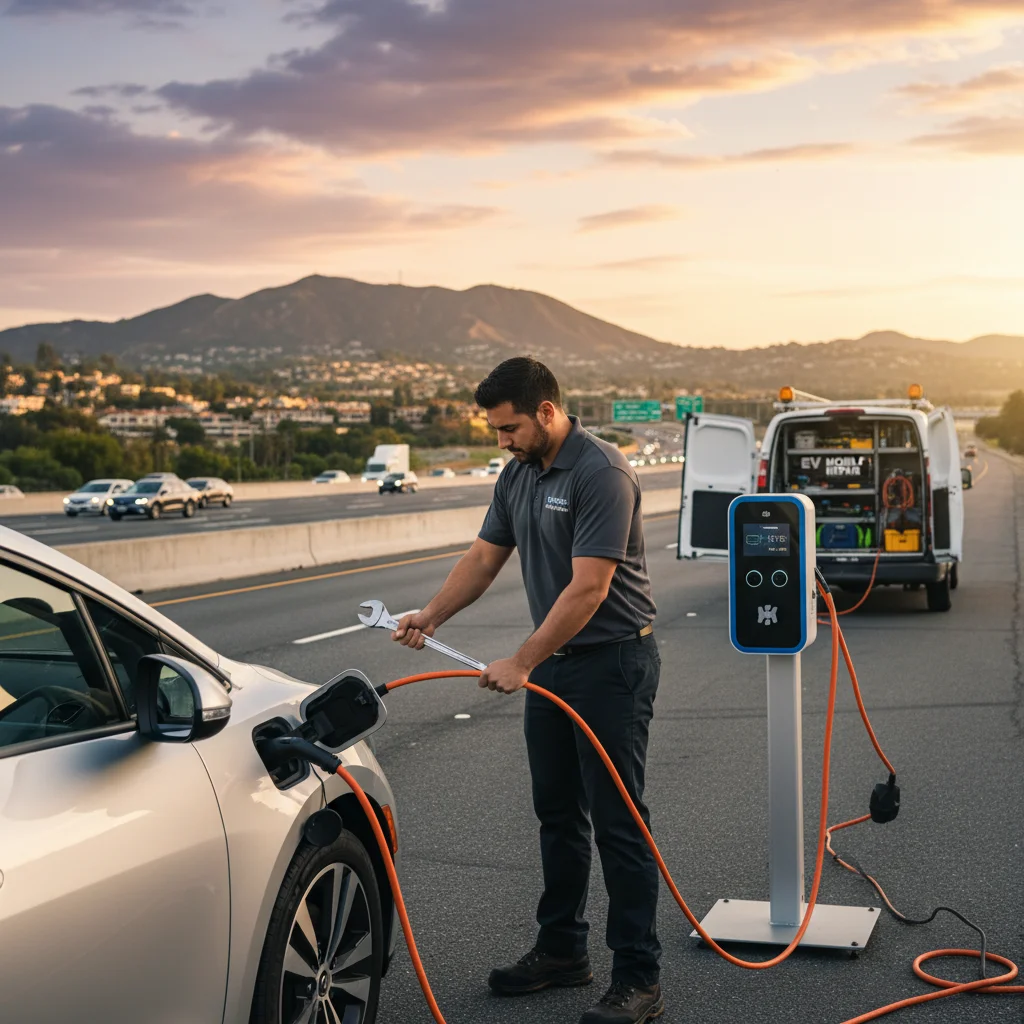
Why Upland EVs stall at home first
Upland is a San Bernardino County city of about 79,000 people. ACS 2019-2023 counts 79,257 residents. The 2024 estimate is 79,684. Median household income sits over a hundred thousand dollars. That mix writes the local stall. People buy the EV first. They discover the panel second.
The city covers about 15.58 square miles. ZIP codes callers mention include 91784 and 91786. Those ZIPs can spill past the city line. Use them as a location hint, not a boundary.
A majority-old housing stock in an affluent city is a panel-capacity problem. A 1960s service was never sized for a wall charger. A Level 1 garage outlet can trickle energy while you sleep. It can’t rebuild a pack after a hot day and extra miles. You unplug in the morning. The estimate looks thin. By the time you reach Foothill Boulevard, the car is already in the red.
Southern California Edison serves Upland. SCE publishes residential EV rates and home-charger programs. Those offers change, and funding runs out. Confirm the current rules on SCE’s EV plan page before you plan a panel upgrade. Charge Pro IE doesn’t install chargers. It doesn’t hold a contractor license. It’s a referral line. It matches stranded drivers with independent local operators.
If the overnight session never happened, start with your EV was plugged in all night and still woke empty. For the panel itself, older Inland Empire panels and EV chargers explains what fails first.
Downtown lots, Metrolink dwell, and Foothill Boulevard
Not every dark EV in Upland died in a garage. Downtown Upland keeps cars parked through long errands. Memorial Park and the Cooper Regional History Museum draw day visitors. Commuters leave a car all day around the Metrolink station. Heat soaks the lot. The 12-volt can quit while the traction pack still holds range.
Foothill Boulevard is the commercial strip. You run into a store. You come back. The handle won’t release. Lights stay out. That pattern is a 12-volt failure more often than an empty pack. The two look identical from the sidewalk. They’re different jobs for the operator.
Colonies and Sycamore Hills sit on the local map with downtown and the Euclid corridor. North Upland above Baseline feeds the climb toward San Antonio Heights. Euclid Avenue, SR-83, still shows the historic median and the horse trail. If the car won’t wake on those streets, start with a 12-volt test. A Level 2 hookup at the curb is the other path.
For city-level routing and the surrounding valley, use the Upland EV charging page.
The climb to San Antonio Heights
Upland sits near 1,443 feet. The ground north of town rises toward the foothills and that climb costs range. Northbound is uphill the whole way. Mountain Avenue, Campus Avenue, and Baseline Road feed that grade. A pack that felt fine downtown can sag on the way up. Regeneration on the descent doesn’t always return what you spent.
Summer heat is severe here. Santa Ana winds come hard out of San Antonio Canyon. Both cut range. Cold mornings in the foothills run colder than valley figures suggest. That cold is a 12-volt problem in winter. The car may look dead in a San Antonio Heights driveway. The pack can still have miles left.
If you lose propulsion on the climb, get out of live traffic if you can. Call 911 first when the position is unsafe. Then ask for a mobile Level 2 visit. Stay put if you’re already stopped. The operator quotes you before any cable goes in. The operator bills you directly.
I-10 cuts the south edge of town. SR-210 hangs along the foothills. Through-traffic from Ontario, Montclair, and Rancho Cucamonga uses both. A low pack on those freeways is a shoulder problem. Pull to a legal, visible stop. Hazard lights on. Then wait for energy at the car if that’s all you need.
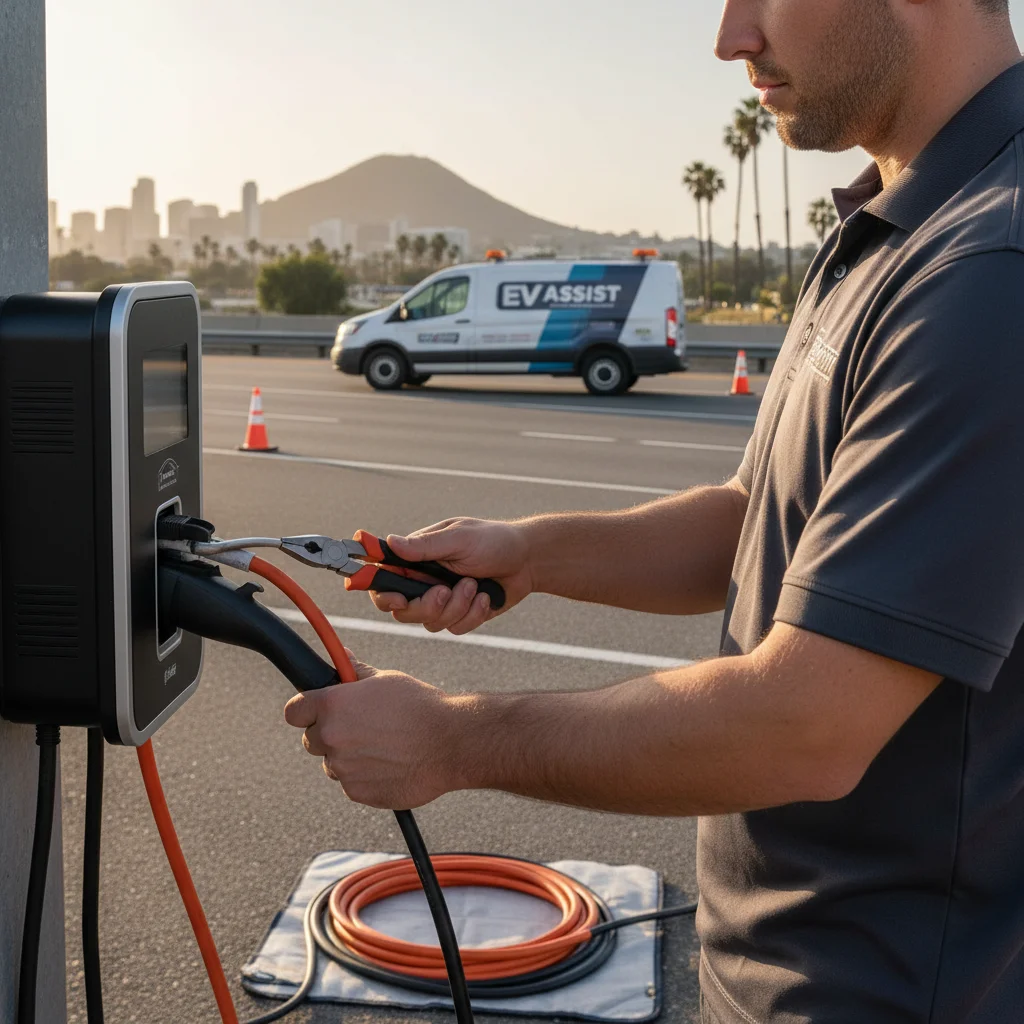
Empty pack, or a 12-volt that won’t boot
Upland drivers use the same sentence for two failures. The car won’t wake.
An empty traction pack follows a night when charging never ran. The old panel tripped. The Level 1 outlet couldn’t keep up. You drove Euclid, then north toward the Heights, on a leftover estimate. The car may still show a screen. It won’t take you far.
A dead 12-volt is different. Locks, lights, and computers stay dark. The big pack can still be fine. Heat on a Foothill lot will do it. So will a cold morning above Baseline. Tesla still uses that small battery to boot. So does every major EV brand the operators handle.
Don’t jump from a random gas car and hope. Have the operator test the 12-volt on site. They can jump it there. They can replace it there if that’s the job. The pattern is spelled out in when the 12-volt dies and the EV looks completely dead.
What a mobile rescue actually is
Charge Pro IE is a referral line. It owns no trucks and no equipment. It employs no technicians. It sets no prices. It promises no arrival time. It publishes no business hours. It holds no license.
Independent operators bring a 240-volt Level 2 source to the car. Tesla takes a native NACS plug. Other EVs use a CCS or J1772 adapter. Typical charging time adds about 10 to 20 miles of range in 15 to 30 minutes. That clock is plug time. It’s never a promise of when someone arrives.
Ten to twenty miles is usually enough to reach a charger you already planned to use. It can also get you home if the house can take a slower overnight session. Compare those two paths in home 240-volt charging vs a roadside Level 2 hookup.
A tow is the right call for crash damage. Use a tow for a failed drive unit. Use a tow when a high-voltage fault won’t clear. An empty pack or a dead 12-volt doesn’t need a flatbed first. The operator charges or jumps in place. You still choose the tow if the car can’t roll safely. For that split, read mobile EV charging vs a tow.
Neighbors on the west valley line
Upland sits against Rancho Cucamonga, Montclair, and Ontario. San Antonio Heights sits above the city. Claremont is next door on the west. A stall that starts on Euclid can end a short drive into a neighbor. Coverage follows the driver, not the city limit sign.
The Upland pattern stays specific. It’s the old house with the new car. It’s the climb into the Heights. It’s the all-day sit downtown and around Metrolink. Don’t copy a neighbor’s story onto these streets.
The U.S. Department of Energy’s AFDC station locator can show public charging you already use. Map your usual stops there when the car still wakes. That locator doesn’t replace a curb rescue when the dash stays dark.
If the car won’t wake
Call when the EV stays dark in the driveway after a planned charge. Call after a long dwell on Foothill or downtown. Call from the shoulder of I-10 or SR-210. Do that only if you’re already stopped in a safe spot.
Charge Pro IE doesn’t perform the work. The operator who takes the job quotes before starting. You pay that operator directly. For a match in Upland, call (909) 250-2881.