When your Ford Mustang Mach-E won’t start on a Cajon shoulder, start with the 12-volt. Dark screens and a dead fob usually mean that small battery failed. It’s often not the traction pack at all. A jump on site is the help that gets most of these cars moving. A long haul down the grade is the wrong first move.
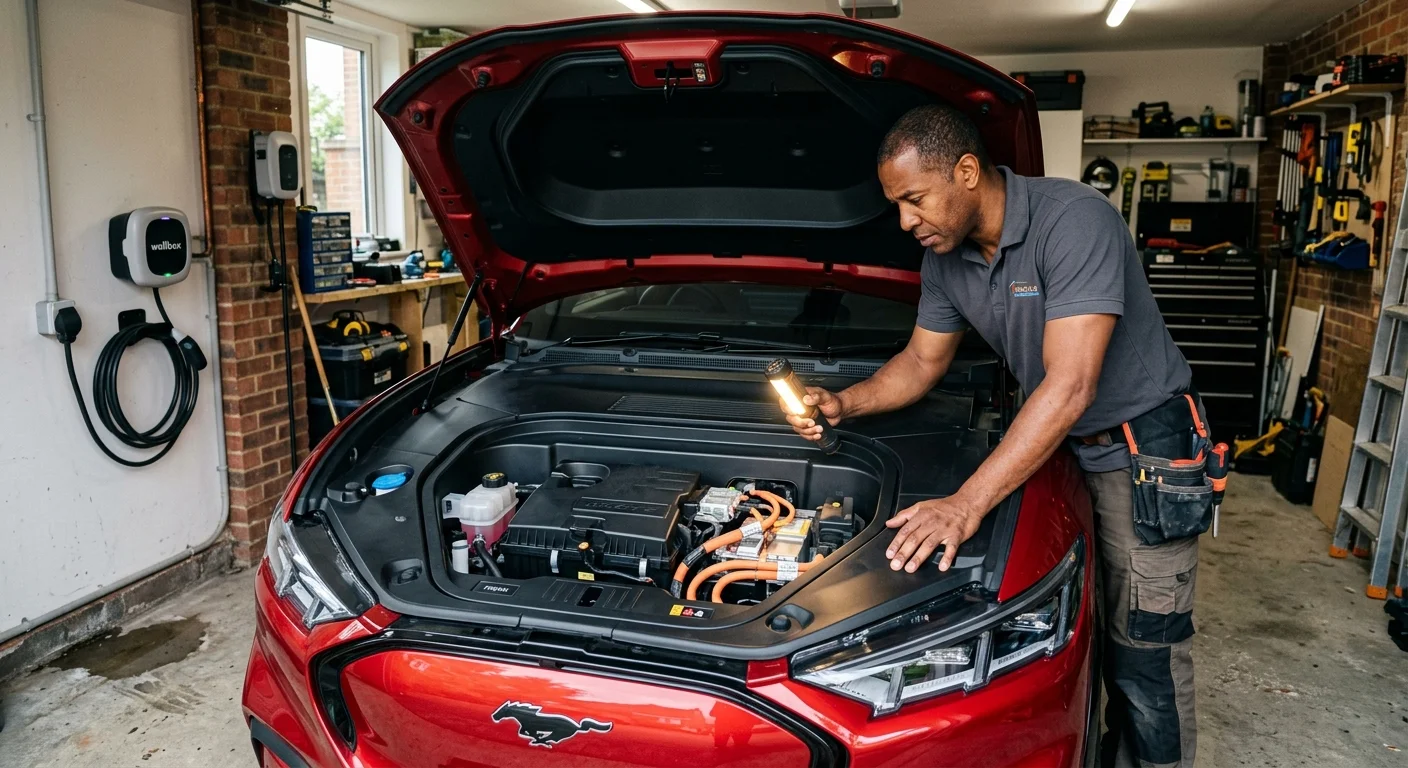
A dark Mach-E on inland grades is often the 12V
The Mach-E still carries a small 12-volt battery. It wakes the computers, lights, locks, and the contactors for the high-voltage pack. If that 12-volt is down, the car won’t wake. The traction pack can still be full, and you just can’t reach it.
Inland heat and accessory drain wear that little battery out. Lots in Fontana and Ontario bake through a full work shift. A run toward Lake Arrowhead adds grade, then a cooler night. Cabin preconditioning overnight pulls from the 12-volt while you sleep. In the morning the fob does nothing, even if you charged the pack.
A low traction pack looks different, because the car usually still wakes. Then it won’t go into drive, or it limits power. It shows a low-charge warning instead of a blank dash. If you emptied the pack on I-15 toward Victorville, treat it as a charge stall. Start with out of charge on I-15 at the Cajon climb toward Victorville. A silent Mach-E in a warehouse row is usually the 12-volt.
What the dash is trying to tell you
Ford’s alerts are useful when anything still has power to show them.
System Off to Save Battery, or a shutdown countdown, usually means the 12-volt is fading. The car’s trying to protect what little is left.
Key Fob Not Detected can be a weak coin cell in the fob. It can also be a 12-volt too weak to hear the fob. Swap the fob battery if you’ve got a spare. If the cabin’s already dark, treat it as a 12-volt stall.
Stop Safely Now isn’t a jump-and-go message. It points at a high-voltage or safety fault. Get off the travel lanes if you can. Don’t treat it like a drained 12-volt.
Service Vehicle Soon wants a shop later, not a shoulder jump.
A blank screen with no chime and no latch is the classic dead 12-volt. That’s the case this page is for. The same pattern is in when the 12-volt dies, why the EV looks completely dead.
How to tell 12V failure from an empty pack
Work a short list before you call a rollback.
If lights, screen, and locks are dead, start with the 12-volt. If the car wakes and won’t move, it’s the pack or a drive fault. A click and a flicker means the 12-volt still has a scrap of charge. It’s not enough to close the contactors.
Fob range collapsing overnight is another 12-volt tell. So is a charge session that never begins because the car never woke. A stuck charge door is a different job. If the cable won’t release, follow Ford Mustang Mach-E charge port stuck: how to free the cable. Don’t yank the handle or you can break the latch.
Ford Lightning owners see the same 12-volt stall in work trim. Details are in Ford F-150 Lightning won’t start: the dead 12V fix.
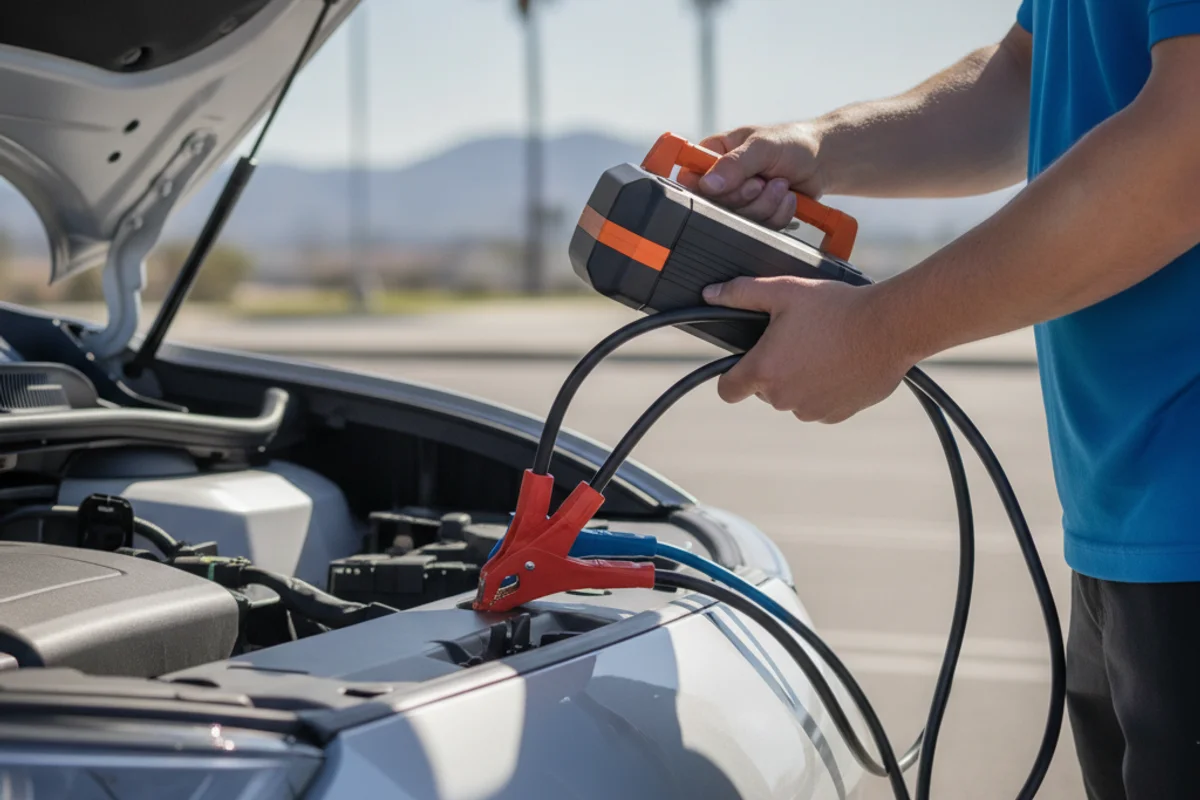
Finding the Mach-E 12-volt without guessing
Ford put the Mach-E 12-volt under the hood, in the frunk. It sits on the passenger side under a plastic cover. Open the frunk with the fob or the interior release, if either still works. Under it, the battery looks like a small conventional 12-volt.
If the frunk won’t open, you’re past a casual DIY. Don’t pry panels or force the latch. Call an operator who knows the manual release for your year.
Ford also gives you jump posts so you can skip the battery terminals. In the frunk, look for a positive post under a red cap. The negative is a nearby chassis ground. That’s a bare bolt or bracket, not a painted strut. Those posts are what you jump to. Leave the covered battery alone unless you’re metering it.
A multimeter on DC volts tells you if the 12-volt is down. Follow Ford’s owner’s manual for your model year, because steps can differ. If you don’t have a meter, skip the test. Use a jump pack or wait for a pro.
Jumping the 12-volt, not the pack
You’re not jumping the high-voltage pack at all. You’re only waking the 12-volt so the contactors can close. Use jumper cables and a working 12-volt car, or a portable jump pack. Keep both vehicles off until the clamps are set.
On the Mach-E, put the red clamp on the positive jump post. Put the black clamp on the marked ground, not a painted bolt. On the donor car or pack, red goes to positive. Black goes to negative or a clean ground. Then power the donor or the pack. Give the Mach-E a short wait, then try to wake it.
If it comes up, disconnect in reverse order. Take the Mach-E positive off last. Keep the car awake after that. Drive it or plug in so the DC-DC can refill the 12-volt. If it dies again in the same stall, that 12-volt is failing. Replacement belongs at a shop, and another jump is only a delay. If a jump doesn’t stick, read EV 12V dies again after a jump: what that usually means. See how to jump start an electric car without frying the 12V for clamp order.
Don’t jump from another EV unless that vehicle allows it, because many don’t. Don’t reverse the clamps, and leave orange high-voltage cables alone.
Pass miles, desert miles, and lots that cook a 12V
The Inland Empire isn’t one climate or one kind of stall. A Mach-E that sat at Ontario airport all shift sat in heat. Fontana warehouse lots do the same to a parked car. A climb toward Yucaipa or Beaumont on I-10 works the pack hard. A Mach-E near Adelanto or Apple Valley baked by day, then cooled at night. Each of those can flatten a tired 12-volt.
The Ortega corridor toward Wildomar repeats it on a two-lane. Drivers find a dark car in a turnout after rural miles. They call for a tow because the screens are black. The operator who shows up often finds a 12-volt, not an empty pack.
Mountain nights around Crestline, Running Springs, and Big Bear Lake add cold. A 12-volt that was marginal in July can fail in a January lot. That still isn’t a reason to flat-bed the car down the grade first.
A car that won’t wake can’t take a public charge. Fix the 12-volt first, then deal with the pack if it’s actually empty.
Home power is a separate map from a dead 12-volt. Riverside Public Utilities serves the city of Riverside. Colton and Banning run their own city electric utilities. Southern California Edison covers most other valley towns. Moreno Valley and Rancho Cucamonga each have a municipal pocket besides SCE. Bear Valley Electric Service covers Big Bear Lake and Big Bear City. Those names matter at home, and they don’t wake a 12-volt on the shoulder.
What a local operator actually does
Charge Pro IE is a referral line. It matches stranded EV drivers with independent mobile rescue operators in the Inland Empire. It holds no license, owns no trucks, and employs no technicians. It sets no prices and publishes no hours. The operator quotes you before any work starts, then bills you directly.
On a Mach-E that won’t start, the pro we send usually begins with the 12-volt. They jump or replace that battery on site when that’s the fault. They handle Tesla and every major EV brand, including Ford. If the pack is empty, they can bring a 240-volt Level 2 source. That hookup uses native NACS, or a CCS or J1772 adapter for non-Tesla EVs. Typical charging time adds about 10 to 20 miles of range in 15 to 30 minutes of charging. That’s plug time, never a promise of when someone arrives.
A silent Mach-E is more often the small battery. Ask the operator to check the 12-volt before anyone hooks the car. Help for CCS and J1772 cars is on non-Tesla EV rescue.
When to stop DIY and make the call
Stop if the frunk won’t open, or if you see Stop Safely Now. Stop if you smell heat from the pack, or orange cables are exposed. Stop if you’re in a live lane and can’t work off the travel path.
If it dies again on the way home, don’t keep jumping it. That battery’s done, so get it replaced. If the car wakes and still won’t move, you’ve left 12-volt territory.
Charge Pro IE serves Temecula, Murrieta, Riverside, San Bernardino, Victorville, and the mountain communities. The number to call is (909) 250-2881. An operator quotes the job before starting. You’re not hiring the brand to perform licensed work. You’re getting matched with a local pro who does.
Frequently asked questions
Why won’t my Ford Mustang Mach-E start?
A dead 12-volt is often why a Mach-E won’t start. A black dash and a silent fob usually mean that small battery failed. The traction pack can still be sitting full. You just can’t reach it until the 12-volt wakes the computers.
Is it the 12-volt or an empty pack?
Treat it as a 12-volt stall when lights, screen, and locks are all dead. A car that wakes but won’t move is a pack or drive fault. An empty pack still wakes and shows a low-charge warning.
Where’s the 12-volt battery on a Mach-E?
It’s in the frunk, on the passenger side under a plastic cover. The battery looks like a small conventional 12-volt unit. Jump at the positive post under a red cap, and a nearby chassis ground. If the frunk won’t open, skip DIY and wait for a local operator.
Can I jump my Mach-E if it won’t start?
Yes, you only jump the 12-volt so the contactors can close. Use a working 12-volt car with jumper cables, or a portable jump pack. Keep both vehicles off until the clamps are set. Never reverse the clamps, and stay off orange high-voltage cables.
When should I stop trying this myself?
Stop if the frunk won’t open or Stop Safely Now is on the dash. Stop if you smell pack heat or see exposed orange cables. If it dies again after you drive off, that 12-volt needs replacement. Charge Pro IE refers you to an independent local operator for on-site 12-volt help.